

From thin-ground Texas hunters to Finnish game knives, these makers give you good reasons to look beyond the usual names.
Tell a custom knifemaker you want a hunting knife, and you have barely started the conversation. A whitetail hunter who does the butchering at home needs something different from an elk hunter carrying everything off the mountain. Add cold hands, a favorite sharpening stone, and a belt crowded with gear, and the details get personal quickly.
That is where custom work earns its price. You can choose a grip that suits your hand, a blade ground for the cuts you actually make, or a finish that marks a hunt worth remembering. The seven makers and workshops below offer different ways to get there. Their individual knives are useful starting points for deciding what matters to you.
If your knife also handles firewood and camp chores, our comparison of bushcraft and hunting knives is worth reading before you settle on a design. A knife that feels right at the skinning pole may feel quite different carving wood.
1. Stuart Davenport
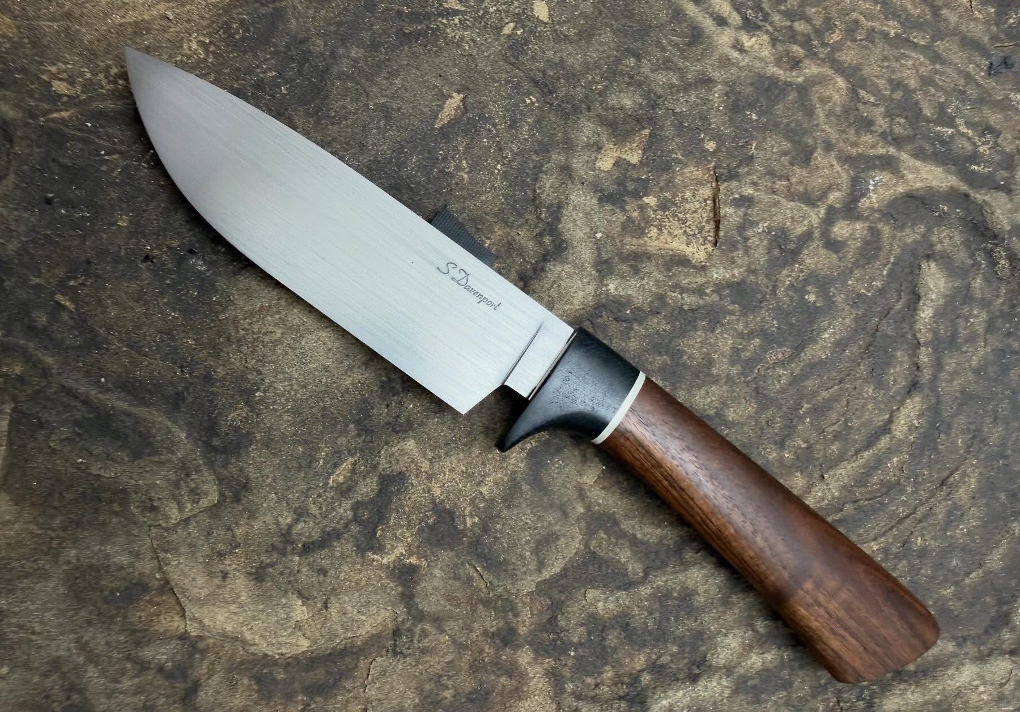
A hunting knife by Stuart Davenport.
Stuart Davenport’s work is worth studying if your current hunting knife feels more substantial than the cutting job requires. The Texas maker puts considerable thought into thin blade geometry, and he publishes enough detail to show what he means.
One Verde Ranch Hunter he completed in 2026 had a 4¼-inch CPM 3V blade, a spine just 0.095 inch thick, and a stated hardness of 62.5 HRC. He used a full flat grind and blended the cutting-edge shoulder into a slight convex.
For a hunter, the attraction is a blade designed to pass through material with less resistance. The limits deserve equal attention: Davenport specifically cautions against cutting bone and other abusive work. Describe your normal cuts honestly when discussing a knife with him. Skinning and boning call for different compromises than splitting a pelvis.
2. Noblie Custom Knives
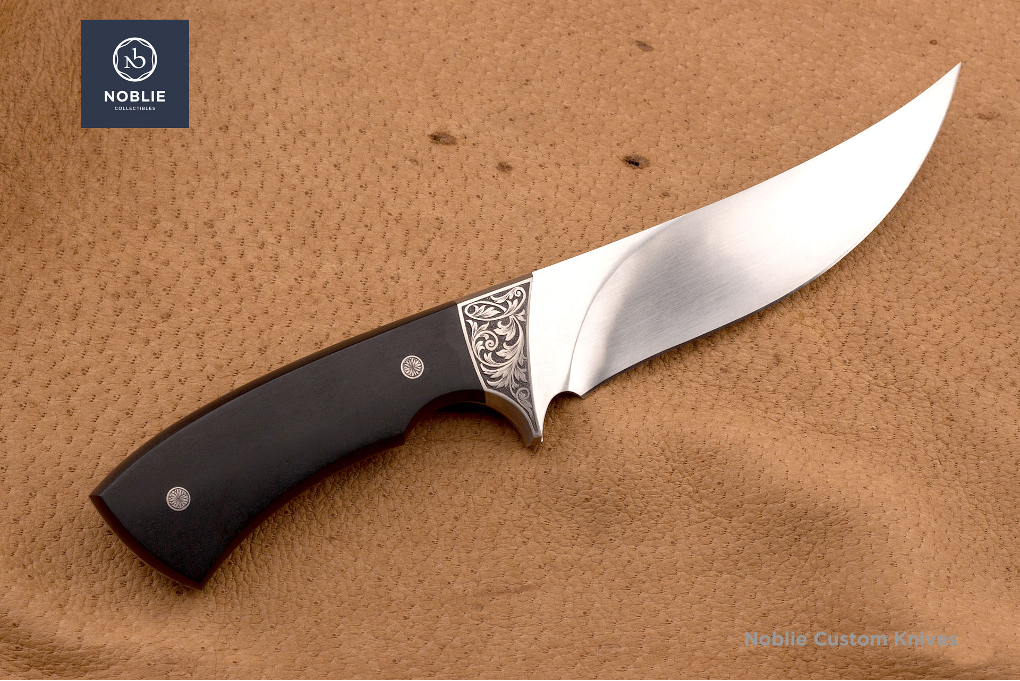
Noblie Custom Knives Full-Tang Deer Skinner.
A retirement gift or a knife commemorating a first successful season gives you another reason to go custom: the handwork can carry part of the story. Noblie Custom Knives brings hunting fixed blades, engraving, and collector work together, with both finished pieces and custom commissions available through nobliecustomknives.com. Its catalog brings together work by multiple makers, giving a buyer room to compare different styles.
Its Full-Tang Deer Skinner shows how decoration can be worked into a recognizable hunting pattern. The listed knife pairs a 4.33-inch Böhler N695 stainless blade with ebony and a vine-engraved titanium bolster.
Its trailing point gives the cutting edge a pronounced sweep, making the shape worth considering for skinning. The raised tip also needs deliberate control during opening cuts.
For a commission, settle the working dimensions first: blade length, handle thickness, finger clearance, and sheath position. Then discuss the engraving and materials. A presentation knife can still be chosen around the recipient’s preferred grip and hunting routine. Keep the maker’s documentation with it, including the steel specification and care instructions; those details will be useful long after the occasion has passed.
3. Josh Mazer, Mazer Custom Knives
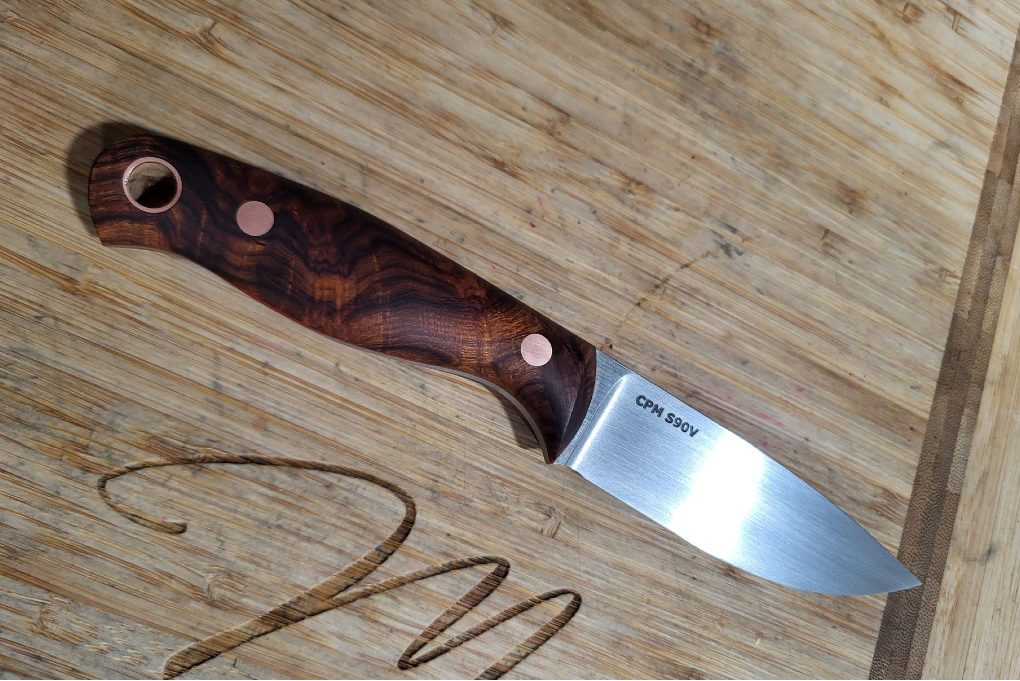
An example of Josh Mazer’s work in CPM S90V.
Josh Mazer spent 26 years in the Navy before retiring from active service in 2022. After more than 15 years of part-time knifemaking, he established his North Carolina company in 2025 to pursue the work full time. His maker’s mark depicts the bow of a ship, viewed head-on. He concentrates on small and medium fixed blades for hunting, outdoor use, and everyday carry.
The Shadow Hunter–Stag is a good example: a 3¼-inch CPM 4V blade made from 3/32-inch stock, a tapered tang, and a stag and Micarta handle. Mazer also makes a three-finger skinner with a 2½-inch blade. Comparing the two raises a useful question about how much handle you want for a long skinning job versus a compact knife carried for occasional use.
His range of steels includes S90V, K390, AEB-L, and others, so explain how you maintain an edge before asking for a particular alloy. A hunter carrying one small field sharpener has a different maintenance plan from someone with a full sharpening setup at home.
4. Alan Johnson, Danum Blades
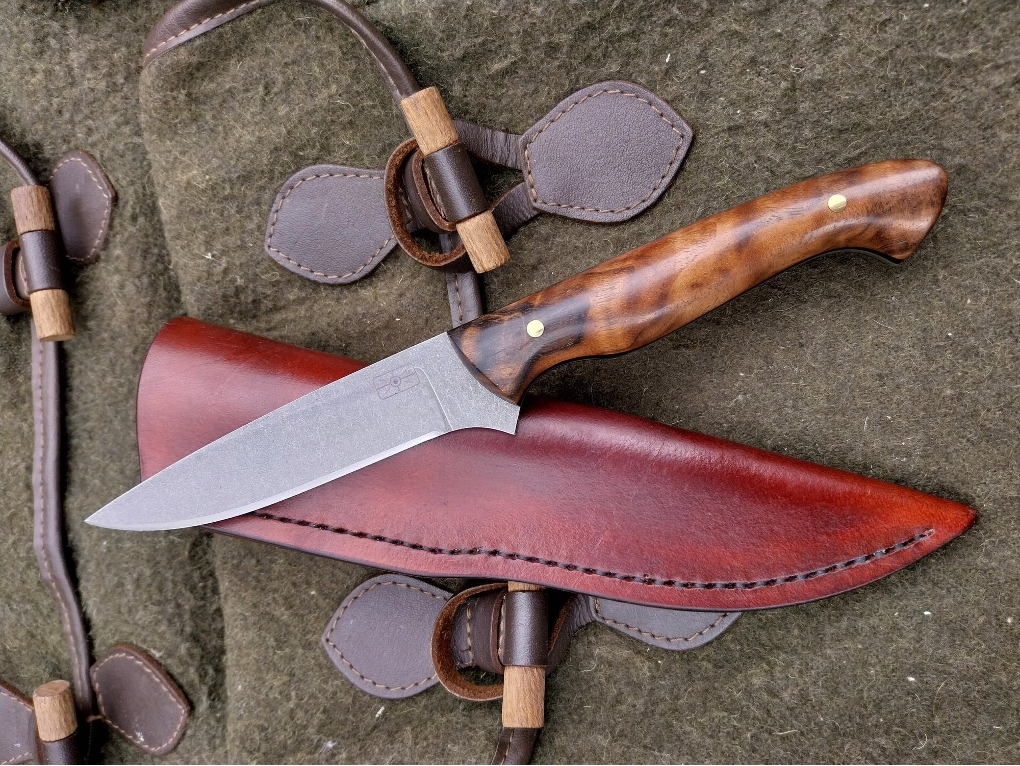
A hunting knife by Alan Johnson of Danum Blades.
Alan Johnson began making knives after following a magazine’s step-by-step instructions in 2009. Eight years later, on his fortieth birthday, he went full time with Danum Blades. The South Yorkshire maker’s background is in shooting and other fieldsports; his catalog includes rifle slings and ammunition pouches as well as knives. Take the Deer Tracker in green and red G10. It has a roughly 4.45-inch blade in 3 mm Sandvik 14C28N stainless steel, a handle about 4.92 inches long, and a Kydex sheath with a webbing belt loop. The blade has a saber grind and secondary bevel.
Before ordering, work out where that sheath will sit alongside your pack’s hip belt or the layers you wear in late season. Ask for a photograph showing the complete belt attachment. A good knife becomes irritating quickly if its sheath rides exactly where your pack buckle needs to go.
5. Jari Liukko, The Knife Workshop Liukko
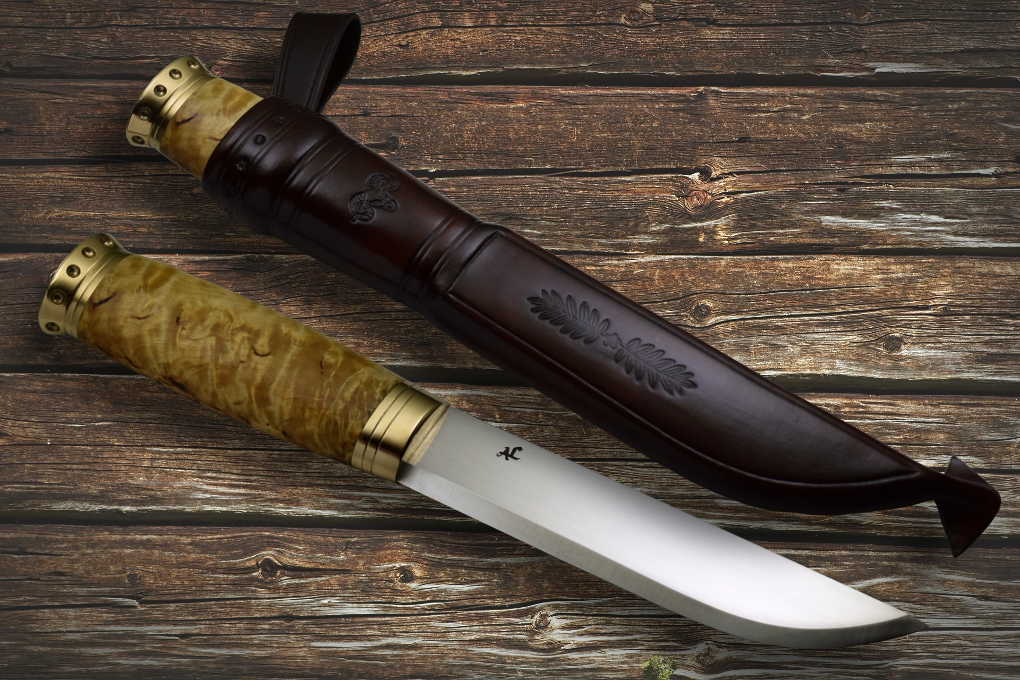
A traditional knife by Jari Liukko.
Jari Liukko works with his father, Arto, in Savonlinna, Finland. Both hold Finnish master knifesmith qualifications; Jari earned his in 2018. Their workshop makes traditional puukkos alongside hunting knives, so there is more here for a deer hunter than an attractive Nordic camp knife. The workshop describes its dedicated hunting knife in terms of game handling, corrosion resistance, and hygiene. The separate Wilderness knife is a general-purpose option for hunters and hikers, listed with a 100 mm, or roughly 3.94-inch, Böhler N690 blade and a choice of oiled curly birch or layered birch-bark handle.
Decide which job you are buying for before getting attached to a handle material. Ask how the proposed blade is ground and how the handle will be finished for your use. A side photograph gives you the outline; a view from the spine tells you much more about the grip’s width and shape.
6. Matt Lesniewski, ML Knives
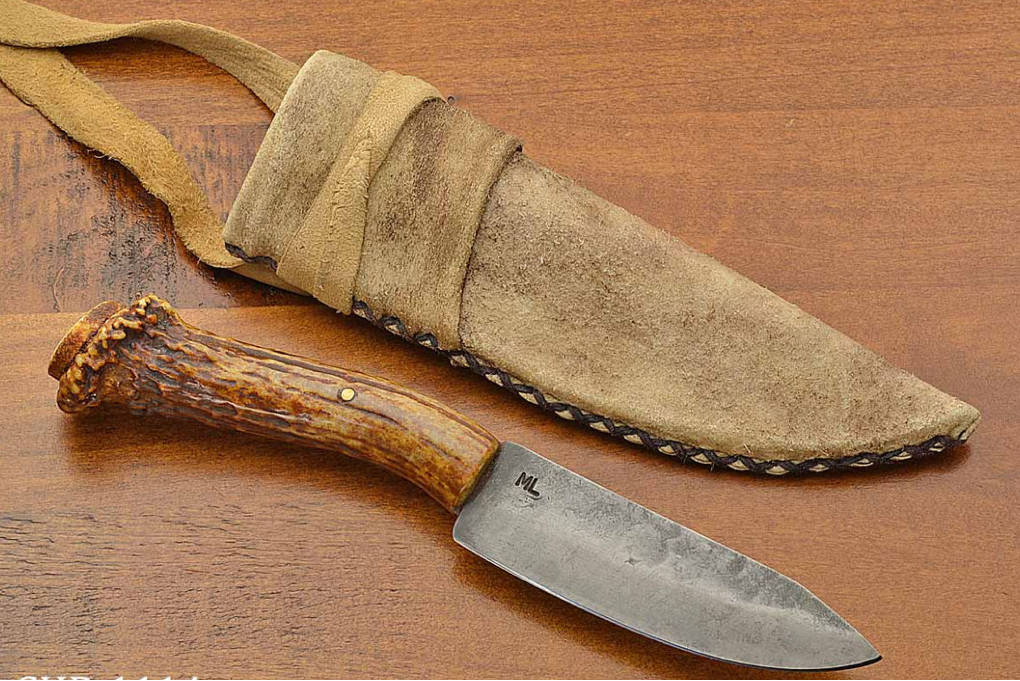
A knife by Matt Lesniewski of ML Knives.
Matt Lesniewski’s knives have an early American character: forged blades, natural handle materials, and leather sheaths made to accompany the knife. Based in upstate New York, he has been making knives since 2001 and uses 1095 as his primary blade steel. He credits his grandfather’s knife with inspiring the career.
His drop-point and Kephart patterns are sensible places for a hunter to begin. Lesniewski also works with antler, bone, and a wide selection of woods. On a custom piece, ask to see the actual handle material and discuss its contours. Two pieces of antler can make handles that feel quite different even when the blade pattern is the same.
This is a maker for someone comfortable with the routine care of carbon steel. Clean and dry the blade after processing game, follow his guidance on protection, and let the leather sheath dry separately when it gets wet.
7. Adam Gray, AA Forge
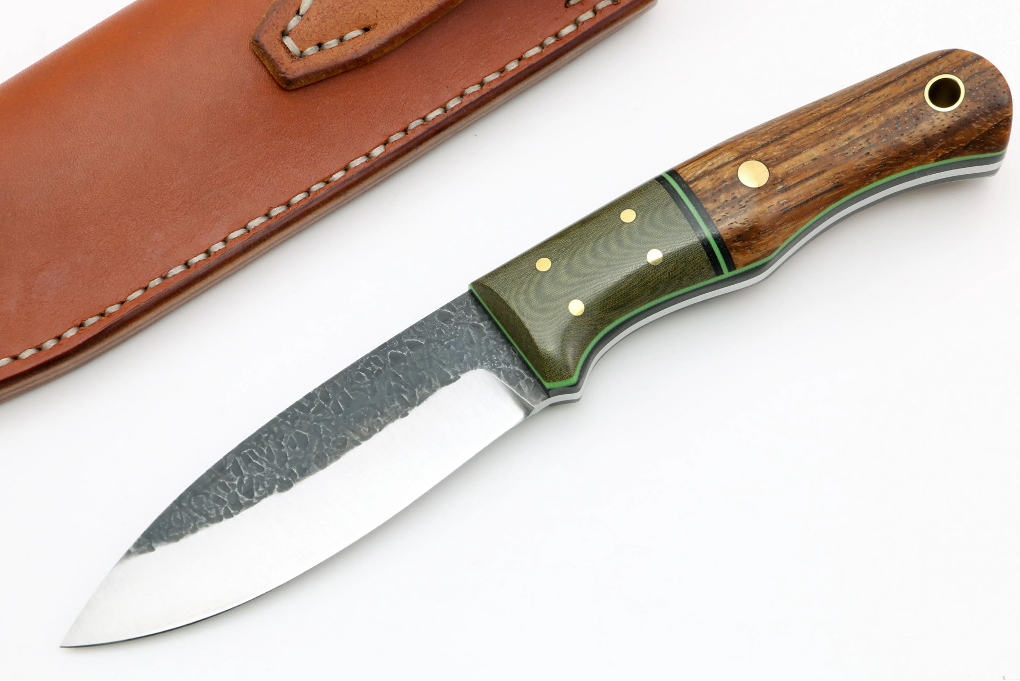
A fixed-blade knife by Adam Gray of AA Forge.
Adam Gray has been making knives full time since 2009 at AA Forge in southwest Ohio. His model range gives hunters a useful way to compare proportions before deciding what to order.
The Mini Walkabout combines a 3⅝-inch blade with a 4⅛-inch handle. The smaller Traveler has a 3-inch blade and a 3⅝-inch handle. That half inch of handle length is worth thinking about if you wear gloves or have found compact knives cramped during a long job. Make a paper outline at actual size, then compare it with a knife you already find comfortable.
Gray also describes his convex grinds and their small secondary edges, which is useful information when planning how to sharpen the knife.
Another reason to look closely at AA Forge is its published touch-up service: sharpening, edge repair, minor handle repair, and refinishing. Ask about the current arrangements and shipping costs. Access to that work can matter years after the initial purchase.
Give the Maker a Useful Brief
Once you have a shortlist, send the maker a description of your hunts and a photograph of your current knife beside a ruler. Explain what you like about it and what you would change. Include these details:
- The game you hunt and the work you do yourself: field dressing, skinning, caping, boning, or all four.
- Your hand size, the gloves you normally wear, and any grip that has caused discomfort.
- The sharpener you carry and how often you are willing to touch up an edge.
- Where the sheath will ride, including belt width and possible interference from a pack.
- Your total budget and the date you need the finished knife.
Before paying a deposit, get the agreed dimensions, steel, grind, sheath, delivery estimate, and service terms in writing. Confirm whether the price includes any engraving or other extras. If you are buying a completed one-of-a-kind knife, request photographs of that exact piece. Small differences in handle shape and sheath construction are often the details that decide whether a custom knife suits its owner.

