
EDGEFIELD, S.C. — Starting on the third Sunday of each October, the nation honors National Forest Products Week, which, for this year, is Oct. 19–25. This week honors the forests that sustain us, the renewable products that come from them and the people and communities who steward these vital resources.
For NWTF members, National Forest Products Week is a reminder of two essential truths:
Forests are more than trees — they are living, working systems that provide wood, fiber, clean water, wildlife habitat, recreation, climate resilience and more.
Healthy forests mean healthy wildlife. For wild turkeys, quality habitat depends on proactive forest stewardship.
Forest restoration isn’t just about trees — it’s about ensuring the long-term health of ecosystems on which wild turkeys and countless other species depend. Through active forest management projects under the National Master Stewardship Agreement, the NWTF and its partners are putting boots on the ground to improve wild places for both people and wildlife.
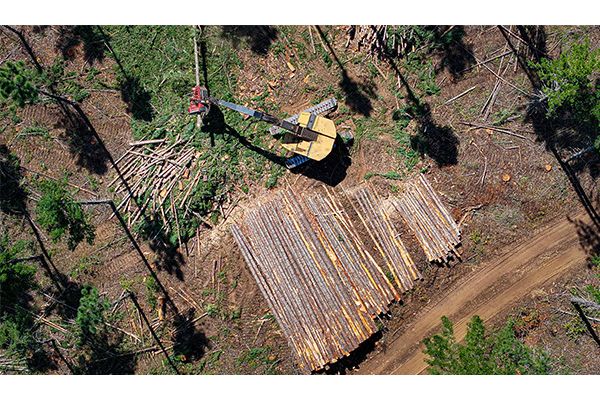
To keep wild turkey populations strong, we must also manage the forests they inhabit. Responsible forest management practices, such as timber harvests and forest thinning, not only provide wild turkeys the habitat they rely upon, but they play a critical role in reducing the risk of catastrophic wildfires, improving forest health and maintaining resilient landscapes.
“These practices don’t just create better wildlife habitat; they also produce renewable wood products that are part of the climate solution,” said Tim Phelps, NWTF wood utilization specialist. “The carbon stored in those products stays locked away for the life of the material — whether it’s lumber, cardboard, furniture or even a whiskey barrel. Compared to concrete, plastic or steel, wood is a far more sustainable, low-carbon choice.”
The wood products industry also fuels rural economies, providing jobs and supporting the same communities that enjoy and care for these forests. It’s a full-circle relationship — one where healthy markets for forest products drive healthy forests, and healthy forests sustain wildlife and recreation.
As forests are thinned or harvested responsibly, new growth, open understories and diverse plant communities emerge, exactly the conditions wild turkeys and other wildlife need for foraging, nesting and brood rearing. And with healthy wildlife populations come rich opportunities for hunting, hiking and recreation, ensuring that the benefits of stewardship extend to all who enjoy the outdoors.
Since the signing of the National Master Stewardship Agreement in 2022, NWTF’s Active Forest Management team has completed numerous projects across the country — many of which contribute to both habitat improvement and the local wood products economy. Here are a few highlights from Fiscal Year 2025:
- Granite Thin Project, Stanislaus National Forest, CA — This project has implemented 33.62 acres of timber harvesting that resulted in 656 tons of material being removed, consisting of primarily ponderosa and Jeffrey pine. The commercial forest material obtained from this project will support local mills, create jobs and stimulate the regional economy while improving forest resilience.
- Umpqua Disaster Recovery Project, Umpqua National Forest, OR — Spanning more than 1,200 acres, the project combines hazardous tree removal, fuel reduction treatments and commercial harvest operations to improve forest health and safety. Starting with a deck sale in early 2025, contractors were able to remove 1,264 tons of biomass that had been decked during suppression activities in 2024. Phase One of the full project began active work in mid-September 2025. Crews will employ a variety of methods — from hand thinning and piling to skyline and ground-based logging — with an estimated 10,000 tons of material to be removed or repurposed as commercial biomass. Beyond reducing wildfire risk, the project will bolster local timber markets and help restore safe public access to the forest.
- Deer Point Forest Stewardship Project, Boise National Forest, ID— This project encompasses more than 1,300 acres of commercial harvest and 225 acres of hazard tree mitigation. Altogether, Region 4 efforts have resulted in 1,275 acres of commercial harvest, 933.71 acres of non-commercial harvest and the delivery of 115 truckloads — totaling 2,897 tons of timber — to Boise Cascade, Woodgrain and local firewood processors.
- First Notch Project, San Juan National Forest, CO — On 600 acres of ponderosa pine, crews delivered 199 truckloads (1,572 tons) of material to Blanca Forest Products and other local markets while improving forest structure and habitat quality.
- Saguache Spruce Stewardship Project, Rio Grande National Forest, CO —This large-scale project targeted 3,411 acres heavily affected by spruce beetle outbreaks. Crews salvaged 1,357 acres of spruce, moving 22,469 tons across 859 truckloads to Montrose Forest Products, supporting the local industry while improving forest recovery.
- South Otter Landscape Restoration and Resilience Project, Custer-Gallatin National Forest, MT/SD — Completed 2,754 acres of timber removal, delivering 4,674 ccf of material through 469 truckloads to Neiman Timber, strengthening both forest health and local economies.
From lumber and clean water to wildlife habitat and recreation, the benefits of America’s forests are woven into every part of our lives. This National Forest Products Week, the NWTF celebrates the interconnectedness of wildlife, working forests and communities. Through active forest management and the sustainable use of forest products, we ensure that our forests — and the wild turkeys that depend on them — remain strong for generations to come.
About the National Wild Turkey Federation
Since 1973, the National Wild Turkey Federation has invested over half a billion dollars into wildlife conservation and has positively impacted over 24 million acres of critical wildlife habitat. The NWTF has also invested over $10 million into wild turkey research to guide the management of the wild turkey population and to ensure sustainable populations into perpetuity. The organization continues to deliver its mission by working across boundaries on a landscape scale through its Four Shared Values: clean and abundant water, healthy forests and wildlife habitat, resilient communities, and robust recreational opportunities. With the help of its dedicated members, partners and staff, the NWTF continues its work to provide Healthy Habitats. and Healthy Harvests. for future generations.

