
NWTF Tennessee Commits $250,000 to Help Establish Nearly 7,500 Acres of Public Land

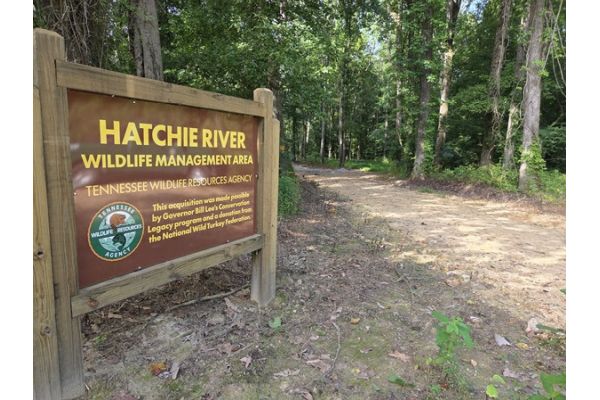
EDGEFIELD, S.C. — After being hunted for gobblers for the first time as public land this spring, the Hatchie River WMA is one of the newest additions to the Tennessee Wildlife Resources Agency’s public land system.
But the 7,457 acres of ecologically rich bottomland hardwood forest didn’t just become open to the public out of thin air. Conservation partners rallied at the opportunity to increase the amount of public hunting land, including the Tennessee State Chapter of the National Wild Turkey Federation.
The passionate volunteers who make up the chapter allocated $250,000 from the Tennessee NWTF State Chapter Super Fund, a funding model where volunteers raise money that is applied to conservation projects.
“Last year, we allocated $500,000 in conservation projects, and $250,000 of that was supporting the Hatchie River WMA,” said Mark Darnell, Tennessee NWTF State Chapter president. “The father of turkey restoration in Tennessee was a TWRA biologist named Jack Murrey. Murrey always said: ‘a dollar sitting in a bank account is not doing the wild turkey any good.’ So, some of us who’ve been around a little while have always kept that saying in the back of our minds, and we’re committed to putting money back into projects — on the local level, the state level and even the national level — that betters the wild turkey on the ground, which will help hunters, conservationists and everybody who cares about our natural resources.”
The purchase was orchestrated by TWRA, in partnership with The Nature Conservancy of Tennessee and The Conservation Fund.
The Hatchie Bottom property now joins over 30,000 acres of conserved lands along the Hatchie River corridor, including Big Hill Pond State Park, Chickasaw State Forest and WMA, Davis Ridge State Historic Area, Grays Creek Wetland, Hatchie National Wildlife Refuge and John Tully State Forest and WMA.
The new property’s ecological significance cannot be understated, as it includes swamps, sloughs, canebrakes and oxbow lakes, supporting over 100 species of fish, 35 species of mussels and more than 250 species of birds, including the majestic wild turkey and elusive birds like Swainson’s warbler.
“This is a truly historic land purchase, both in terms of its size and its ecological significance,” said Roger Shields, TWRA wild turkey program coordinator and NWTF Wild Turkey Technical Committee member. “Securing more than 7,000 acres in one acquisition is remarkable on its own, but the fact that it spans over 10 miles of the Hatchie River, preserving the incredible bottomland hardwood forests and connecting several existing tracts of protected land makes it even more significant. In a region with limited natural habitat, this addition will greatly benefit wild turkeys that depend on the river corridor. We’re very excited to have this important new piece of conservation land.”
But as important as the acquisition is, managing it for wildlife habitat through various forest management activities is just as important.
The Tennessee NWTF State Chapter plans to collaborate with TWRA on numerous wild turkey habitat projects on the new WMA in the coming years, including reforestation, timber harvest, creating wildlife openings, post-timber-harvest treatments and more.
“It is an honor to work with our volunteers in Tennessee who take bold steps to move our mission forward,” said Derek Alkire, NWTF director of conservation operations for the Habitat for the Hatch Initiative. “And the purchase to help establish the Hatch River WMA is a prime example — increasing public lands and access for sportsmen and women, conserving habitat into perpetuity and opening new doors to manage for wildlife. This is volunteer work at its finest.”
About the National Wild Turkey Federation
Since 1973, the National Wild Turkey Federation has invested over half a billion dollars into wildlife conservation and has positively impacted over 25 million acres of critical wildlife habitat. Since 2022, the NWTF has also invested over $2.3 million in critical wild turkey research that, when leveraged with partner contributions, has resulted in more than $22 million to guide the management of the wild turkey and to ensure sustainable populations. The organization continues to deliver its mission by working across boundaries on a landscape scale to create healthy forests and wildlife habitats, clean and abundant water, resilient communities and robust recreational opportunities. With the help of its dedicated members, partners and staff, the NWTF is committed to creating a nation united by the life-changing power of the outdoors.
