
NWTF, Texas Parks and Wildlife Improve 106 Acres of Wild Turkey Habitat at Kerr WMA


The National Wild Turkey Federation and Texas Parks and Wildlife Department have completed a 106-acre habitat improvement project at Kerr Wildlife Management Area near Hunt, Texas, aimed at improving roosting, nesting and foraging habitat for Rio Grande wild turkeys.
Completed in March 2026, the project focused on three areas of the WMA where increasing densities of Ashe juniper, commonly called cedar, had begun encroaching on important turkey habitat. Through targeted mechanical brush removal, crews reduced cedar cover in riparian corridors and surrounding uplands, creating opportunities for native grasses and other herbaceous vegetation to recover.
The work builds on ongoing wild turkey research at Kerr WMA, where researchers have identified frequently used travel corridors and roosting sites, helping guide habitat management toward areas important to local turkey populations.
For Rio Grande wild turkeys, the wooded creek corridors of the Texas Hill Country provide valuable roosting habitat and connections between feeding, nesting and other seasonal habitats. At Kerr WMA, ongoing research has identified two riparian corridors, one in the northern portion of the property and another in the south, that are frequently traveled by wild turkeys.
Over time, Ashe juniper had become increasingly established within these creek bottoms, growing beneath and around mature hardwood trees and changing the structure of the surrounding habitat.
In the northern treatment area, mature live oaks and cedar elms serve as important turkey roosting trees. Crews used basal cutting, a method of removing woody vegetation near ground level, to clear encroaching cedar from around these desirable hardwoods while retaining the trees turkeys rely on. Similar work was completed along the southern creek corridor, where crews cut cedar and stacked the removed material outside the creek bed.
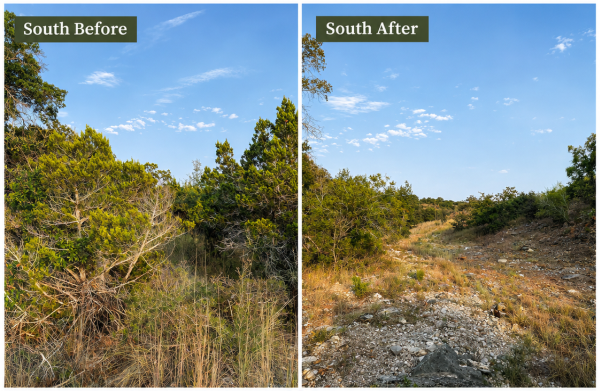
By reducing dense cedar growth in these areas, the project helps maintain the structure and accessibility of important roosting and travel habitat while creating space for desirable native vegetation.
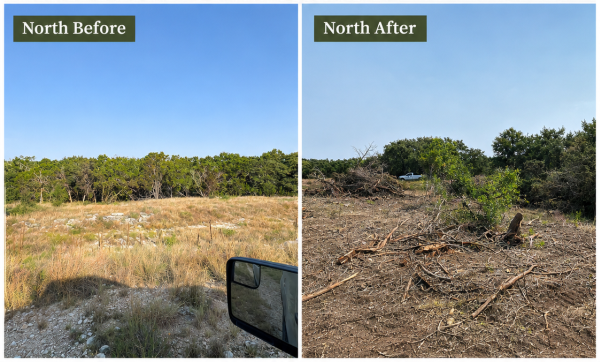
Beyond the creek corridors, the largest portion of the project focused on 89 acres of upland habitat in the center of Kerr WMA. Here, crews removed regrowth cedar to improve known roosting areas and encourage the recovery of native grasses and herbaceous plants.
This vegetation plays an important role in the life cycle of wild turkeys. Grasses and other low-growing plants provide nesting cover, while diverse herbaceous vegetation supports the insects and other food sources that developing poults depend on. Reducing woody encroachment can also help maintain the more open habitat conditions that Rio Grande wild turkeys use for feeding and moving across the landscape.
Together, the riparian and upland treatments address different habitat needs within the same landscape, improving conditions across areas turkeys use throughout their life cycle.
“One of the most valuable aspects of this project is that the habitat work is being guided by what we’re learning about how wild turkeys actually use the landscape,” said Annie Farrell, NWTF district biologist for Texas, Oklahoma, Kansas and Nebraska. “By protecting important roosting trees, improving travel corridors and encouraging native vegetation in surrounding uplands, we’re addressing several of the habitat needs turkeys have throughout the year. It’s a great example of how research and active habitat management can work together to support wild turkey conservation.”
Although mechanical brush removal is complete, the work at Kerr WMA is part of a longer-term habitat management strategy. Texas Parks and Wildlife Department staff will continue managing the treated areas through prescribed fire, follow-up brush management and vegetation monitoring.
In the northern and southern riparian treatment areas, crews will finish stacking and burning cut cedar during winter 2026. Prescribed burns are planned for the northern area in January 2028 and the southern area in January 2029, allowing time for native herbaceous vegetation to recover.
In the central upland treatment area, cut cedar will remain on the ground until a planned prescribed burn in January 2028. This approach is intended to encourage the growth of desirable plants before fire is reintroduced and support the recovery of herbaceous cover afterward.
Kerr WMA staff will also conduct annual photo monitoring to document vegetation changes following treatment. Additional GPS tracking of wild turkeys may help researchers better understand how habitat improvements influence roosting behavior and habitat use over time.
For the NWTF, the project demonstrates the importance of combining research, targeted habitat treatments and long-term management to improve conditions for wild turkeys. By working with Texas Parks and Wildlife Department to improve habitat at Kerr WMA, the NWTF is helping support healthier landscapes and the future of Rio Grande wild turkeys in the Texas Hill Country.
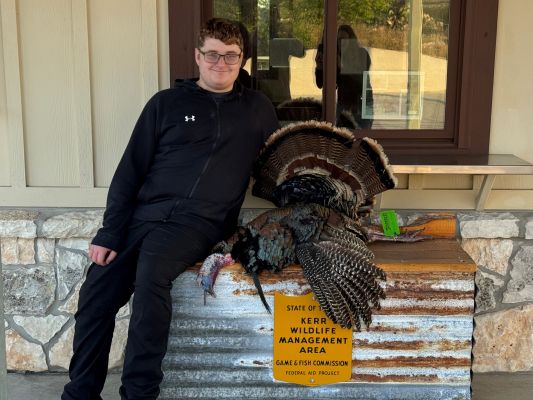
From protecting mature roosting trees to restoring native ground cover, the work is designed to ensure the habitat wild turkeys depend on remains productive for years to come.
